
Introduction:
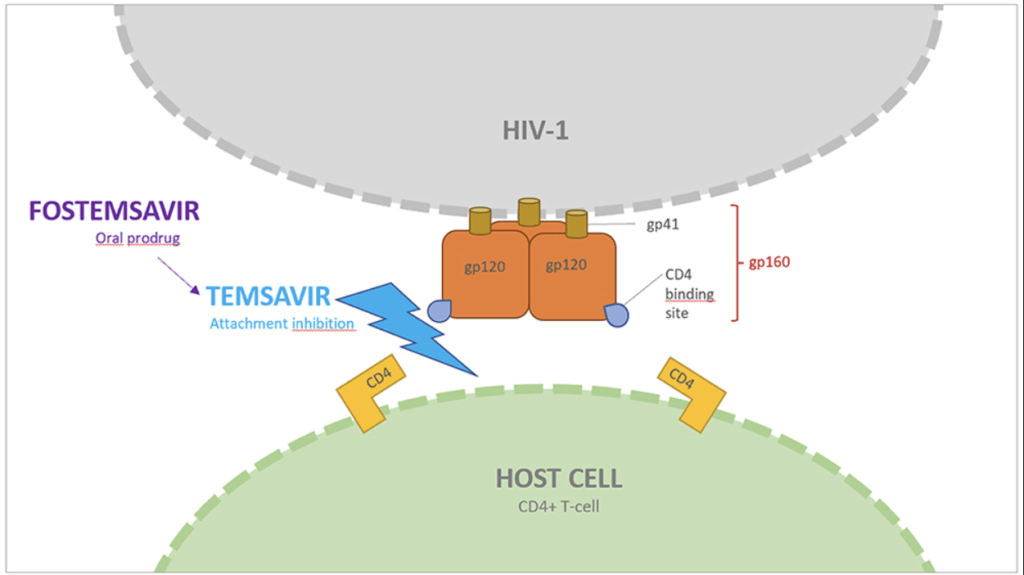
Fostemsavir is a first-in-class HIV-1 attachment inhibitor approved for heavily treatment-experienced adults with multidrug-resistant HIV-1 infection. It is an orally administered phosphonooxymethyl prodrug that is rapidly converted to the active metabolite, temsavir. Temsavir binds the conserved pocket on the HIV-1 envelope glycoprotein gp120 adjacent to the CD4-binding site, preventing viral attachment to CD4+ T cells and blocking viral entry at the earliest stage of infection.

Key advantages:
- Activity against HIV strains resistant to reverse transcriptase, protease, and integrase inhibitors, with no cross-resistance to these established drug classes.
- Fostemsavir is administered as a 600 mg extended-release tablet twice daily in combination with an optimized background antiretroviral regimen.
- The pivotal BRIGHTE Phase III trial demonstrated durable viral suppression and improved CD4 cell counts in heavily treatment-experienced patients with limited treatment options. Resistance is mainly associated with mutations in the viral gp120 protein (e.g., S375H, M426L, M434I, M475I). Strong CYP3A inducers such as rifampicin and carbamazepine significantly reduce drug exposure and should be avoided.
- From a pharmaceutical development perspective, the phosphonooxymethyl prodrug strategy substantially improves the oral bioavailability of temsavir while maintaining potent antiviral activity. Key development considerations include phosphate prodrug synthesis, regiochemical control, extended-release formulation, and management of drug–drug interactions.
- Fostemsavir represents a significant therapeutic advance by targeting viral attachment rather than intracellular replication, providing an effective option for patients with multidrug-resistant HIV-1.
Medicinal Chemistry:
Fostemsavir is a landmark example of rational prodrug design in antiviral medicinal chemistry. It is an orally active phosphonooxymethyl prodrug of temsavir, a potent HIV-1 attachment inhibitor that binds the conserved gp120 envelope glycoprotein and prevents viral attachment to CD4 receptors. Although temsavir exhibited excellent antiviral potency, its poor aqueous solubility and limited oral bioavailability restricted its clinical utility. Medicinal chemists addressed these limitations by introducing a phosphonooxymethyl promoiety, markedly improving aqueous solubility, gastrointestinal dissolution and systemic exposure without altering the active pharmacophore.
The structure–activity relationship (SAR) studies established that the heteroaromatic core and hydrophobic substituents of temsavir are essential for high-affinity binding within the gp120 pocket. Because modifications around this pharmacophore significantly reduced potency, optimization focused on physicochemical properties rather than receptor interactions. Following oral administration, endogenous phosphatases rapidly cleave the phosphate ester to release active temsavir.
From a medicinal chemistry standpoint, fostemsavir demonstrates the successful integration of structure-based drug design, prodrug chemistry, ADME optimization and formulation science. It targets a viral protein–protein interaction rather than intracellular enzymes, providing activity against HIV strains resistant to reverse transcriptase, protease and integrase inhibitors with minimal cross-resistance. Key development challenges included scalable synthesis of the phosphorylated intermediate, regioselective phosphorylation, impurity control, and formulation of a stable extended-release dosage form.
Overall, fostemsavir exemplifies how rational optimization of drug-like properties, while preserving the active pharmacophore, can transform a promising lead molecule into a clinically successful medicine. It remains an outstanding case study in modern medicinal chemistry, illustrating the value of prodrug strategies for overcoming developability barriers while maintaining potency, selectivity and therapeutic efficacy.
Commercial Synthesis & Key Intermediates:
Commercial development of fostemsavir (BMS-663068) is a notable example of modern process chemistry in which an efficient discovery route was transformed into a robust, scalable and commercially viable manufacturing process. The initial kilogram-scale synthesis was adapted directly from the medicinal chemistry route to rapidly deliver approximately 100 kg of material under aggressive development timelines. Subsequent route-scouting identified a superior commercial approach that reconstructed the azaindole core from simple pyrrole building blocks, improving raw material availability and scalability.

Critical process innovations included mechanistic optimization of the Friedel–Crafts acylation, development of a scalable acylation–chlorination–amidation sequence, robust Pictet–Spengler cyclization followed by radical aromatization, regioselective C5 bromination, and telescoped operations to eliminate isolation of unstable intermediates. The oxalyl side chain was introduced using phase-transfer catalysis with a one-pot amidation protocol suitable for >200 kg production. Installation of the triazole fragment through an Ullmann–Goldberg–Buchwald coupling provided excellent regioselectivity, while conversion of the API to its lithium salt improved solid-state properties and downstream processing.
The final commercial step employed an efficient phosphonooxymethylation followed by deprotection and tris-salt formation to furnish fostemsavir with consistent purity while eliminating problematic slurry-to-slurry transformations. Overall, the commercial synthesis emphasized route simplification, telescoping, impurity control, process robustness, scalability, and product quality, demonstrating how integrated process chemistry can convert a complex discovery synthesis into an economically viable manufacturing process.
Zasya has developed an efficient, scalable, and non-infringing process for the manufacturing of Temsavir, the active moiety of Fostemsavir. Leveraging our expertise in advanced process chemistry and pharmaceutical intermediate development, Zasya offers a reliable supply of high-quality key intermediates to support API manufacturing programs.
The following Temsavir intermediates are available for commercial sourcing and custom supply upon request.
| Sr. No. | Key intermediates | Cas No |
| 1 | 1-(phenylsulfonyl)-1H-pyrrole | 16851-82-4 |
| 2 | 4-methoxy-1-(phenylsulfonyl)-1H-pyrrolo[2,3-c]pyridine | 1421517-99-8 |
| 3 | 7-bromo-4-methoxy-1-(phenylsulfonyl)-1H-pyrrolo[2,3-c]pyridine | 1421517-89-6 |
| 4 | 2-(4-methoxy-7-(3-methyl-1H-1,2,4-triazol-1-yl)-1H-pyrrolo[2,3-c]pyridin-3-yl)-2-oxoacetic acid | 676491-47-7 |
| 5 | 1-(4-benzoylpiperazin-1-yl)-2-(7-bromo-4-methoxy-1H-pyrrolo[2,3-c]pyridin-3-yl)ethane-1,2-dione | 1449413-23-3 |
| 6 | 1-(4-benzoylpiperazin-1-yl)-2-(4-methoxy-7-(3-methyl-1H-1,2,4-triazol-1-yl)-1H-pyrrolo[2,3-c]pyridin-3-yl)ethane-1,2-dione | 701213-36-7 |
References:
- BMS-663068: Another Quiet Victory for Chemistry. Ming Yan; Phil S. Baran * Org. Process Res. Dev. (2017) 21 (8): 1091–1094.